HOW 3P WORKS

People. Process. Product. One business system.

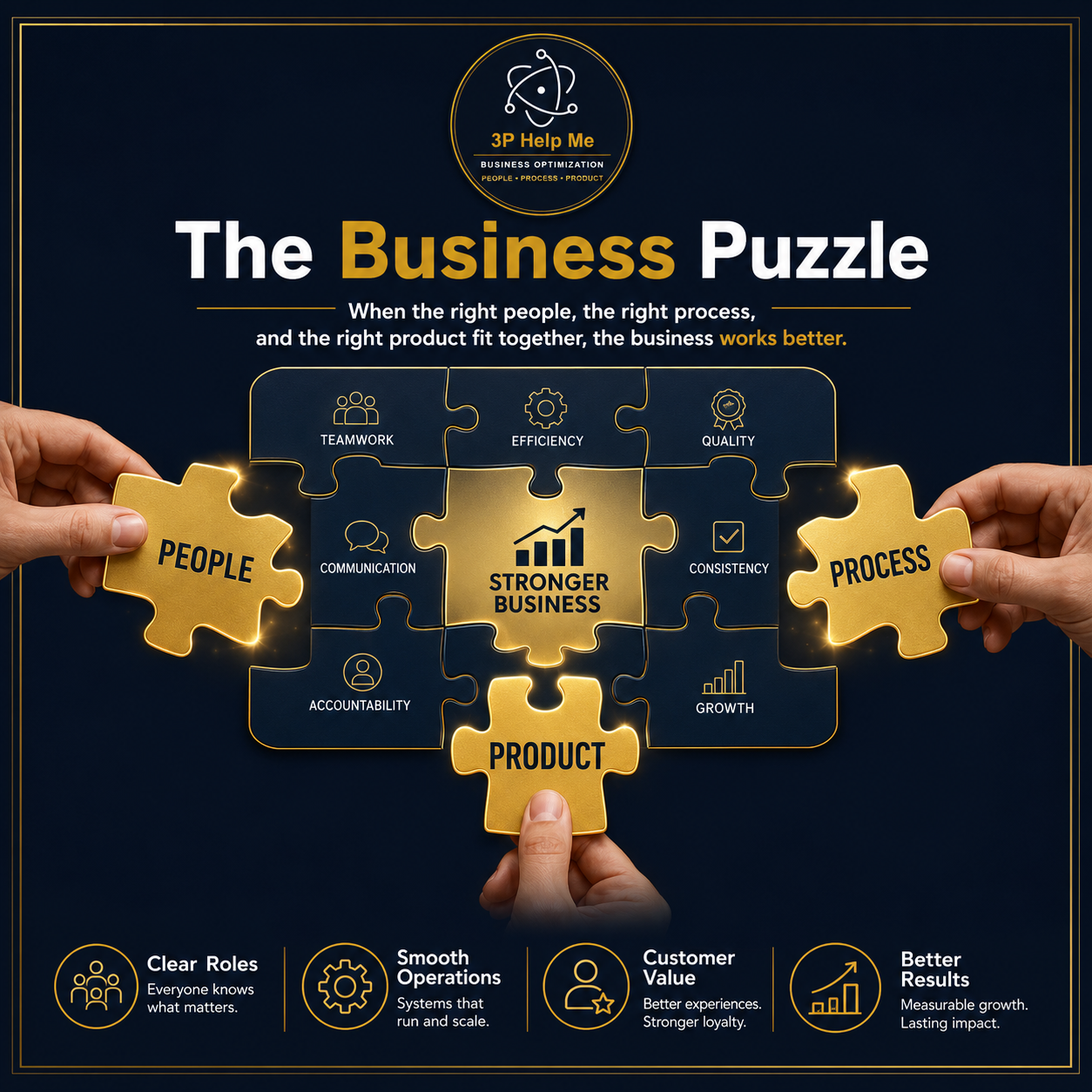
3P improves the way work gets done by looking at the people doing the work, the process moving the work, and the product or service the customer ultimately receives.

THE 3P FRAMEWORK

Every operational problem touches all three.

The Business Puzzle — when the right people, the right process, and the right product fit together, the business works better.
PEOPLE

Roles, capacity, decisions, skills, and ownership

Who performs the work? Who owns the result? What decisions can they make? Do they have the information, training, tools, and capacity required?

  • Role and responsibility clarity
  • Workload and capacity
  • Training and standard work
  • Decision rights and accountability
PROCESS

The path work follows from request to result

What happens first? Where does information wait? Which steps are repeated? What triggers the next action? How are exceptions handled?

  • Workflow and handoffs
  • Delays, waste, and rework
  • Controls and quality
  • Automation and integration
PRODUCT

The value delivered and the economics around it

What does the customer receive? What does it cost the business to deliver? Does the experience match the promise? Is the work profitable and repeatable?

  • Customer requirements
  • Service or product quality
  • Pricing and delivery cost
  • Profitability and scalability
THE METHOD

3P does more than point out what is wrong.

Recommendations only create value when they can be implemented, used, and sustained. The 3P method moves from diagnosis through implementation and then verifies whether the change actually improved the business.

Practical over theoretical.

The best process is not the most impressive diagram. It is the simplest dependable way for this business, with these people, customers, resources, and constraints, to produce the required result.

THE 3P IMPROVEMENT CYCLE

From symptom to sustainable result.

Listen and observe.

Understand the owner's concern, the team's experience, the customer's impact, and the operating environment.

Define the problem.

Separate the symptom from the root cause and establish what successful improvement should change.

Measure the current state.

Use available data, timing, workload, errors, backlog, financial impact, and direct observation to create a grounded baseline.

Design the improved state.

Simplify the flow, clarify ownership, establish standards, select tools, and define how normal work and exceptions will be handled.

Implement with the people doing the work.

Build, configure, test, train, and adjust with real operating feedback rather than handing over a document and walking away.

Verify and sustain.

Confirm that the change produced the intended result, document the working standard, and identify what should be monitored going forward.

WHAT CLIENTS CAN EXPECT

Clear work, visible decisions, and no unnecessary complexity.

TRANSPARENCY

You will know what is being worked on.

Scope, responsibilities, required information, decisions, timing, and changes are documented rather than left to assumption.

REALITY

The recommendation must fit the business.

Budget, staffing, location, skill level, customer expectations, workload, and current technology are treated as real design constraints.

IMPLEMENTATION

The work moves beyond advice.

When included in scope, 3P helps build, configure, organize, test, document, and launch the improved way of working.

MEASUREMENT

Improvement should be visible.

The result may be faster turnaround, fewer missed steps, reduced owner involvement, cleaner data, lower rework, better capacity, or improved cash flow.
WHICH PATH FITS?

Start with the kind of help the business needs now.

On-Demand Operations Support is the right path when work needs to be organized, completed, cleaned up, set up, or maintained.

Systems, Automation & Integration is the right path when the same problem continues to return and the underlying workflow needs to change.

Not sure which one applies?

The Operational Snapshot is designed to identify the operational pressure, likely cause, and most practical starting point without requiring the owner to choose a consulting category first.

Improve the business as a whole—not one symptom at a time.

Start with the problem that is consuming the most time, delaying the most money, or placing the most pressure on the owner.